
The same assistant that answers questions on this site now captures who you are, honors how you've asked to be contacted, and follows up — automatically. Kinetiv extended its own agent into a working demand-gen engine.
The situation
Our first build proved Kinetiv could stand up a real Microsoft 365 Copilot agent — one that answers buyers' questions and lets them act. But generating interest is only the first half of a demand engine. We had a way to create leads and no scalable, measurable way to capture and engage them.
That gap was about to matter. We were preparing to run real digital advertising and email campaigns — the kind that only work if every click is tracked, every contact is filed, and every follow-up fires on its own. Doing that by hand might survive a quiet week; it would not survive a campaign. And we refused to build the engine reactively, after leads had already slipped through. We wanted it standing before the traffic arrived.
There was a harder constraint underneath. Running modern campaigns means collecting contact data, and collecting contact data means honoring how each person has agreed to be contacted — consent and privacy intent carried correctly from the first click all the way through every email that follows. That isn't a feature you bolt on afterward. It has to be wired into the foundation.
And one engagement tool wasn't enough. The platform that runs email and nurture well (Brevo) isn't built for the next-action, relationship-driven selling that moves a lead through a pipeline — that's a different kind of system (OnePageCRM). So the build had to feed both: one system to engage, one to act.
This was also the thing we'd be building for clients. Standing it up for ourselves first was the point.
The approach
As always, we started by defining what success looked like before building anything: a visitor engages the agent, and from that single interaction the right things happen automatically — the contact is captured, their consent is recorded and respected, they're filed into both the engagement system and the sales system with their original source preserved, and, if they've opted in, they enter an automated follow-up sequence. No manual capture. No manual data entry. No follow-up that depends on someone remembering.
The insight that shaped the whole build: the value wasn't a chatbot on the front of the site. It was connecting that chatbot, seamlessly, to the systems behind it. We extended the existing agent — the same one from our first build — with the integrations and automated flows that turn a conversation into business activity. The agent became the orchestration layer, reaching from the front door through to capture, consent, CRM, and follow-up as one governed flow.
Built inside Kinetiv's own Microsoft 365 environment, on Microsoft Copilot Studio, the flow routes each capture by what the visitor wants and how they've consented. Someone subscribing is handled differently from someone applying or asking to be contacted — each routed to the right destination. Consent is captured once and honored everywhere downstream: a marketing message and a transactional confirmation travel different paths, and someone who never opted in is never marketed to. Every contact is written to both the engagement platform (Brevo) and the action-oriented CRM (OnePageCRM), with their first-touch source frozen at the moment of capture so campaign performance stays attributable later. Consented contacts converge into an automated nurture sequence that won't double-send or message anyone who's opted out. And the whole thing is instrumented — consent-gated analytics and ad-platform tracking — so the campaigns it feeds can actually be measured.
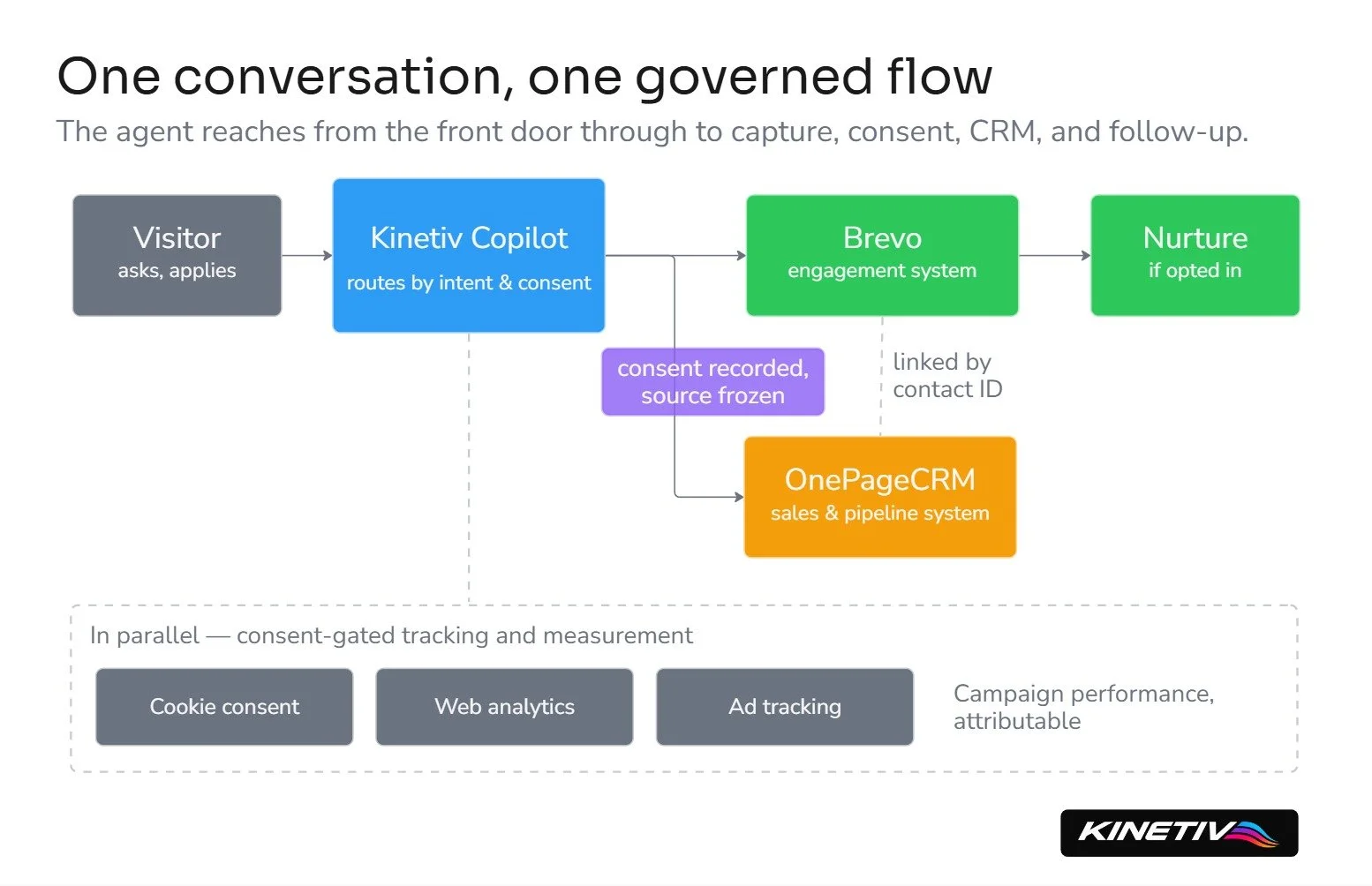
Kinetiv Copilot as orchestration layer — routing capture by intent and consent, writing to both systems at once, governing consent end to end.
What it does now
The flow is live and verified end-to-end. A visitor engages the agent, and the contact lands in both systems with consent and original source recorded correctly. Opted-in contacts enter the automated follow-up sequence on their own. Marketing and transactional messages travel their correct, consent-gated paths. Campaign tracking carries through from click to capture. None of it requires a person in the loop.
The campaigns this engine feeds haven't run at volume yet, so what's here is a working system, not a stack of conversion numbers — and we'd rather show you the machine than quote results it hasn't earned. What it proves is the harder thing: an agent that doesn't just talk, but reaches into the systems that run the business and drives a governed process end to end. That's what a demo can't show you, and it's the part that's genuinely hard to build.
What this would otherwise cost
Built the conventional way — custom integration work, a consent-and-privacy layer, dual-system writes, ad and analytics instrumentation, and automated nurture — this composite would run a US mid-market company somewhere from a conservative floor near $33K into six figures in the first year, plus the recurring cost of the manual operating labor it removes. Kinetiv built it inside its existing Microsoft 365 environment, extending an agent it already had.
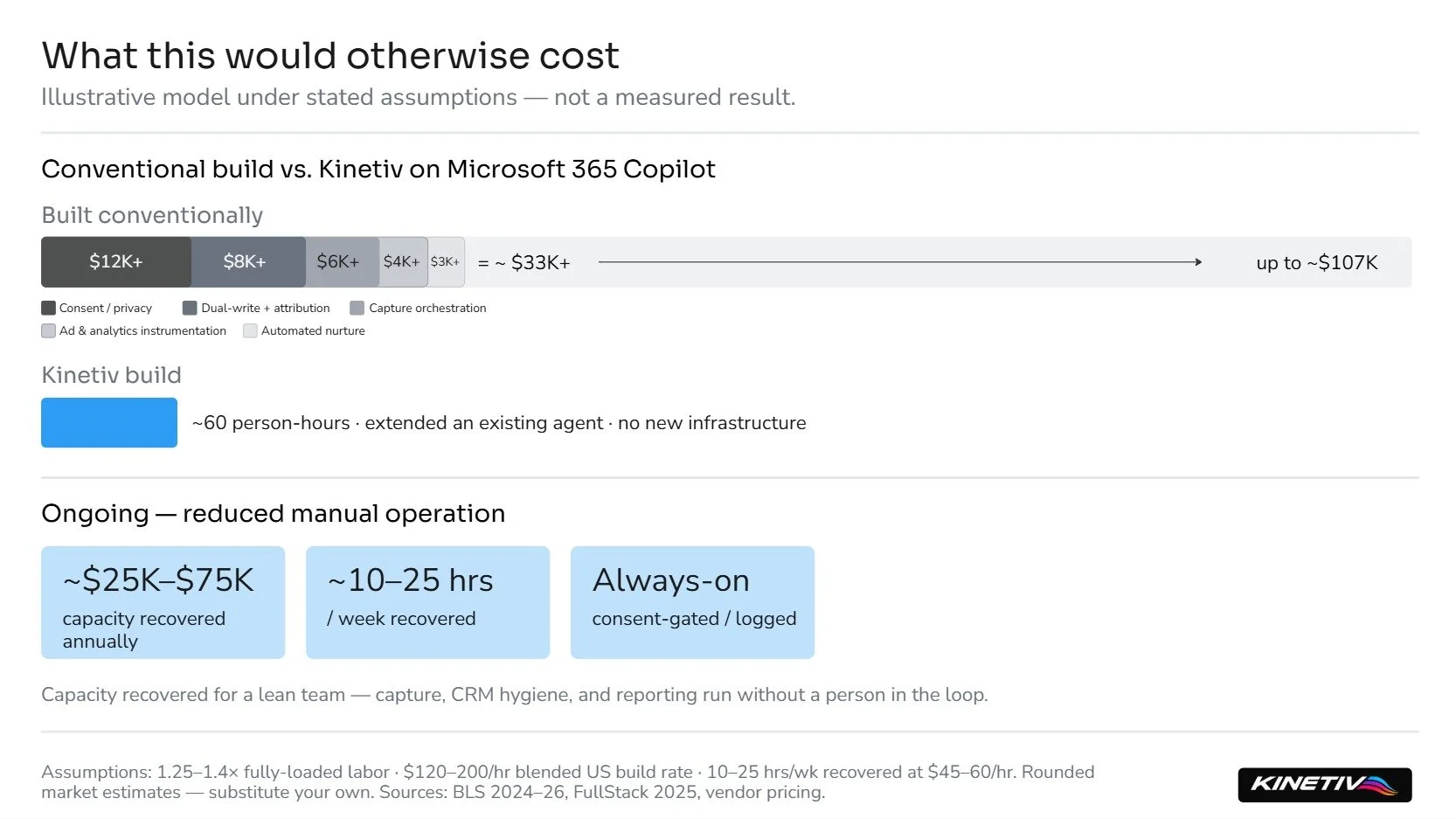
What the same capability would cost to build conventionally — five components priced separately — against Kinetiv's ~60-hour build. Illustrative model, not a measured result.
What this means for you
A chatbot that answers questions is one thing. An agent wired into the systems that run your business — capturing, governing consent, filing where work actually happens, following up, all measurable — is another. Kinetiv built its own before asking anyone to trust the approach.
We'd build yours the same way: the Founding Client Program opens this to three companies — a no-cost AI Opportunity Assessment and a working agent prototype, built in your own Microsoft 365 environment, against a real use case. Apply for the Founding Client Program.