
The assistant answering your questions on this site is the case study. Kinetiv built it on the same Microsoft 365 Copilot stack it builds on for clients — in under a week.
The situation
Kinetiv launched as a bootstrapped startup — no outside funding, no existing clients, and none of the public case studies a buyer reaches for when deciding whether a new firm can actually deliver. That's a hard spot to sell from. We were asking mid-market companies to trust us with their Microsoft 365 Copilot investment, with nothing to point to but our own claims.
A website can assert expertise. It can't demonstrate it. And the buyers we serve — the COO accountable for the Copilot investment, the CEO who needs visible progress instead of another roadmap, the IT director who deployed Copilot but isn't seeing business value, the AI lead who has the mandate but needs a method — don't want to read every page to find out what an engagement costs, whether they qualify, or how to start a conversation. They expect to ask and get an answer, and to act when they're ready, without booking a call with a stranger first.
So we had two problems that turned out to be one: we needed proof we could build a real Microsoft 365 Copilot agent, and we needed our own site to serve the buyer's journey it described. Building our own assistant solved both at once.
The approach
We started where every Kinetiv engagement starts — by defining what success looked like before building anything. Not "ship a chatbot," but a specific bar: a visitor can get any in-scope question answered accurately, can apply to the Founding Client Program, book a consultation, or request more information — all without a human in the loop, and without the agent ever making something up. The agent also had to be the proof: built to the same production standard we'd hold a client's build to.
We mapped the buyer's journey the agent had to support — awareness through decision — and designed it inside that journey rather than bolting a Q&A box onto the site. That design didn't happen in a vacuum. As we shaped Kinetiv's whole buyer experience — site, services, value proposition, and the assistant as one part of it — we pressure-tested our thinking with a panel of advisors who know this buyer well, with deep Microsoft and go-to-market experience. Their reactions to what a buyer actually needs shaped what the agent does and how it behaves.
Then we built it, on Microsoft Copilot Studio, inside Kinetiv's own Microsoft 365 environment — no new infrastructure. The agent pairs deterministic topics for the high-intent paths (apply, contact, book a call) with generative answers grounded in Kinetiv's own content, so it answers naturally without drifting off-scope or hallucinating. Application and contact submissions route through Outlook to a shared mailbox we monitor. The first working version went live in under a week.
What it does now
The agent is live on kinetivconsulting.com today. A visitor can ask what Kinetiv does, what an engagement costs, or whether they qualify — and get an accurate answer drawn from real site content. They can apply to the Founding Client Program, request a consultation, or send a question, and it reaches us. It holds its scope: ask it something outside what it knows, and it redirects rather than hallucinating an answer.
We'll be honest about what this is. A site that answers questions and lets a buyer act is table stakes now — it's what people expect when they're shopping for a provider. The point isn't that the capability is novel. The point is how fast we stood up a real, governed agent on the Microsoft 365 Copilot stack, and that the thing fielding your questions right now is the demonstration. Early prospects have engaged the site and moved forward — including one who signed an agreement with Kinetiv after spending time with it.
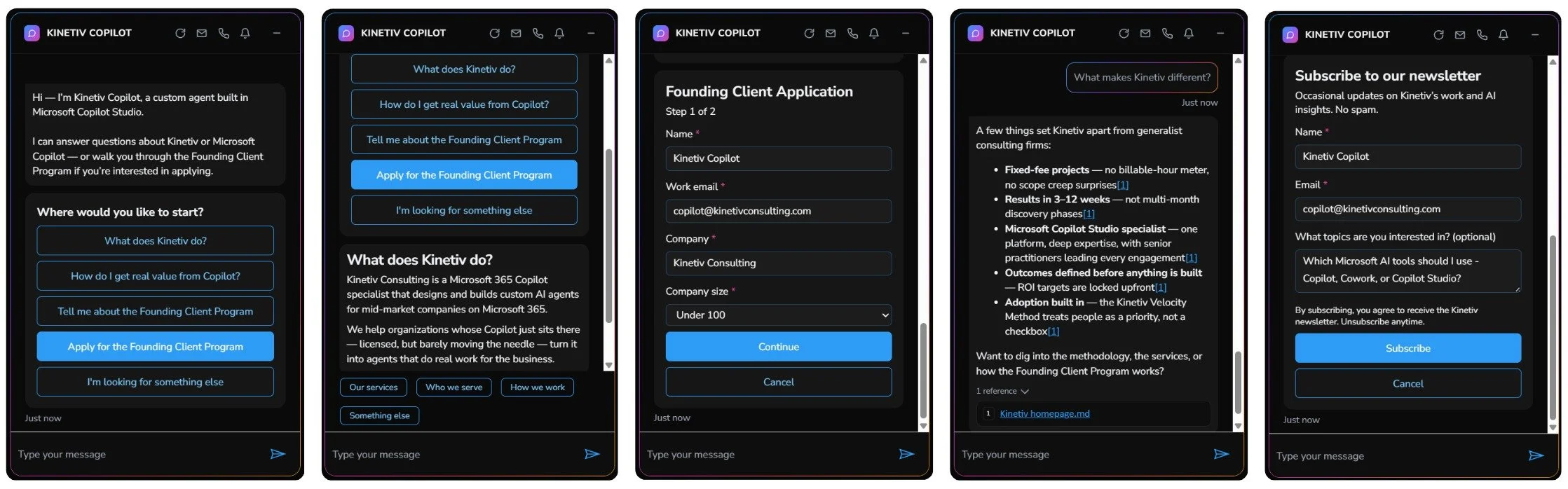
Kinetiv Copilot in action on kinetivconsulting.com — providing deterministic and generative answers grounded in real site content, accepting Founding Client Program applications, and receiving newsletter signups — all without a human in the loop.
What this would otherwise cost
A comparable agent built the conventional way runs tens of thousands of dollars and weeks of development. Kinetiv built this in roughly 40 hours on Microsoft Copilot Studio, with no new infrastructure — and it keeps handling pre-sales questions that would otherwise land on a person.
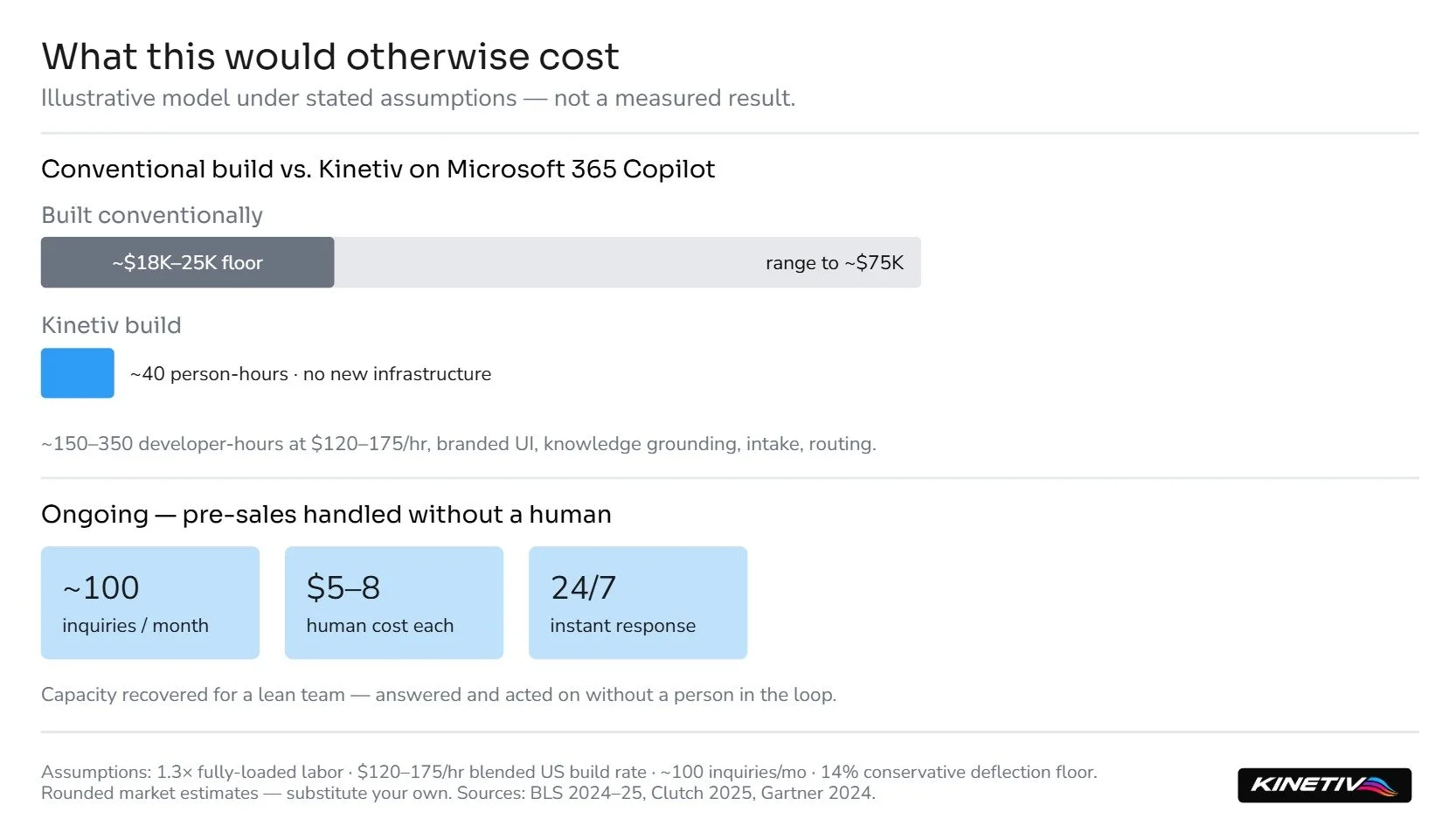
What a comparable agent would cost built the conventional way, versus Kinetiv's ~40 hours on Microsoft 365 Copilot. An illustrative model under stated assumptions — not a measured result.
Setting the bar
If Kinetiv will build its own buyer-facing agent on its own website, in days, before asking anyone else to trust the approach — that's the bar we hold for the work we do for you. The Founding Client Program opens that to three companies: a no-cost AI Opportunity Assessment and a working agent prototype, built in your own Microsoft 365 environment, against a real use case. Apply for the Founding Client Program.