
There's a moment a lot of us know by now. You're deep in the work, the deadline is close, and the fastest way through is to hand some of the load to Claude or ChatGPT. Except the material in front of you is a client's. It's sensitive — maybe confidential, maybe covered by a contract you signed. And the tool that would make the next hour easier is the one tool you're not supposed to use for exactly this.
So you sit with it for a second. Would anyone even know?
I won't pretend that question has never crossed my mind. The pull is real, and it gets stronger the better these tools get. Anyone who tells you they've never felt it is either not doing the work or not being straight about it.
What's supposed to meet you in that moment is policy — your company's, or your client's, the rules about what goes where. And policy, right now, is the part that hasn't caught up.
The rules are behind, in both directions
The gap shows up two ways, and they pull against each other.
Some rules are too blunt. Faced with a technology moving faster than anyone can write guidance for, plenty of organizations reached for the simplest control available: restrict it, broadly, and sort out the details later. That instinct is understandable — and it's widespread. In Cisco's 2024 Data Privacy Benchmark Study, 27% of organizations said they'd banned generative AI outright, at least for a time, and 63% had limited what data could be entered into it. But a rule written only to reduce exposure can quietly buy something worse: the person most able to deliver faster, sharper work is now required to pretend the tool doesn't exist, and the quality goes down with it. A ban is easy to write and expensive to actually live inside.
Other rules are careful but don't reach the field. A thoughtful policy — real data-classification tiers, clear guidance on which tools are cleared for which kind of information — is only as good as the delivery team's understanding of it under deadline pressure. And the understanding is often thin, because the people writing the rules are themselves a step behind the pace of the tools. When the guidance-writers are unsure, the people doing the work are more unsure still — unclear on what they're allowed to use, with which data, and when.
That second gap is where the quiet workaround lives. The research says as much: in Cisco's study, nearly half of respondents — 48% — admitted to entering non-public company information into these tools, restrictions notwithstanding. The rule says one thing; the laptop at 11 p.m. does another. That space between the policy and the practice is where the real risk sits, and it's widening, not closing.
Why this got urgent now
None of this was pressing two years ago, because the choice barely existed. If you couldn't use the public tool, you mostly did without. Three things changed that at once.
The open models got good. Not frontier-beating — the best closed models still lead, and lead clearly on the hardest reasoning and agent work — but the gap narrowed from a chasm to a few months. Epoch AI, which tracks this, now measures the best open-weight models as trailing the closed frontier by about four months. Models you can run on your own hardware now handle the everyday substance of knowledge work — summarizing, extracting, drafting, answering questions against your own documents — well enough to matter.
The governance hardened. Restricting public AI tools for sensitive data went from unusual to expected — the Cisco numbers above are the shape of it, and they're from early 2024; the direction since has been toward more control, not less.
And the ground under the data shifted. Regulation and contract language increasingly care not just about whether your data is stored, but about where it physically sits and who could compel access to it. For some kinds of work, that question alone takes the public cloud off the table.
When the choice didn't exist, there was nothing to decide. Now there is.
When "go local" is the real answer — and when it isn't
Here's the part worth being careful about, because it's easy to oversell.
Most of the "I can't paste this in" problem is not solved by running your own model. It's solved by using the right tier of the tools you already know. The free consumer versions are genuinely a poor place for confidential work — but the business and enterprise tiers of the same tools make real, contractual commitments. Anthropic, for instance, states plainly that it does not use data from its commercial products to train its models — a different posture from the consumer app. A lot of the fear is aimed at the free tier and doesn't survive contact with the enterprise one. If your only worry is "the consumer app might learn from this," the answer is usually a better tier, not a new machine under your desk.
But that tier doesn't resolve everything. There's a class of work where the data genuinely cannot leave your control — where the bar isn't "a vendor promises not to look" but "no outside party can reach it, by design." Classified material. Client contracts that forbid cloud processing outright. Regulated or proprietary data where the physical location of the server, and who has legal reach into it, is itself the problem. For that work, the only setup that actually satisfies the requirement is one where the model runs on hardware you control and the data never leaves the room.
That's the real case for going local. Not because it's cheaper, and not because "local" sounds private. Because for a specific and growing slice of the work, it's the only way to use a capable AI tool at all — instead of doing without, or quietly cutting the corner.
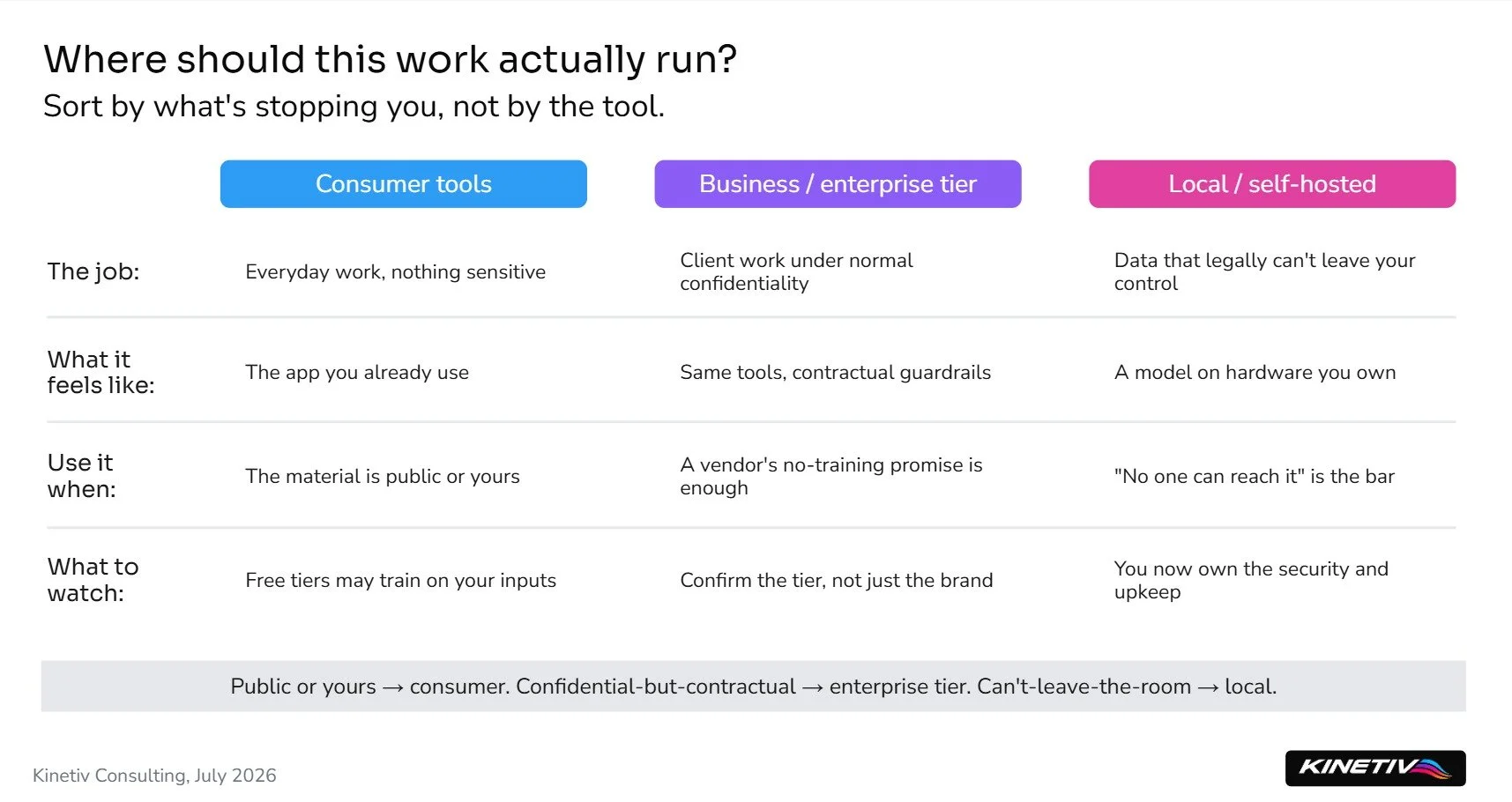
The three places AI work can run — and the question that sorts them. Match the tool to the data, not the other way around.
Starting to think about the path
If you've got work that genuinely belongs off the public tools, running a capable model yourself is more approachable than it was even a year ago — and still not a download-and-done afternoon.
The models themselves are free and open. The capability costs hardware. A local model's real bottleneck is the graphics card and the memory it runs on, and that's where the money goes — a modest setup runs the smaller models fine; the genuinely capable ones want serious graphics memory, or one of the newer machines built with a lot of it. Getting a model running is easy now; a couple of well-known tools have made it a first-afternoon thing. Getting a model running well, securely, and kept current is the actual work — because a model on a box you own is a box you now have to secure and maintain, and a poorly-secured local setup can be a worse exposure than the governed cloud you were trying to avoid.
So the honest first question isn't "which model" or "which graphics card." It's narrower: what, exactly, is the work that can't go anywhere else? Size the setup to that. The answer is usually smaller and more affordable than the enthusiast forums make it sound — because you're not trying to replace the frontier. You're covering the slice of work the frontier tools aren't allowed to touch.
What rules don't solve
The temptation I opened with doesn't go away because a policy tells it to, and it doesn't go away because you resolve to have more discipline. Under a real deadline, discipline is usually the thing that loses.
It goes away when the right tool is as easy to reach as the risky one. That's the actual work here — not writing a stricter rule, but closing the distance between what's allowed and what's easy, so the person under pressure isn't choosing between doing the work well and doing it right.
The policies will catch up. The tools already have. The work in between is sorting out which of your work belongs where — and making sure the honest option is the one within reach when it's late and the clock is running.
Sources
Cisco 2024 Data Privacy Benchmark Study — 27% of organizations banned generative AI at least temporarily; 63% limited what data could be entered; 48% admitted entering non-public company information into these tools.
Epoch AI, "Open models lag state-of-the-art closed models by 4 months" — the best open-weight models trail the closed frontier by about four months, measured since January 2026.
Anthropic Privacy Center, "Is my data used for model training?" — Anthropic does not use inputs or outputs from its commercial products (Claude for Work, API, Claude Gov) to train its models by default.