
A colleague introduced me to a leader at a bank who wanted his team to get more from AI. In our first conversation, he told me a couple of other AI consultants had walked him through what he'd learn in training, and it had felt academic. He wanted to see firsthand what he'd be able to do with AI.
He had plenty of interest, and he'd already sat through the overviews. What he couldn't do yet was picture AI doing his team's actual work.
Where a lot of teams are
That's a common place to be. Many organizations hear they need an AI strategy first, so they wait, or they commission a plan, and in the meantime the work runs the way it always has. Often some of their people are already using AI on their own.
You don't need an elaborate AI strategy before you start. Plan just enough to choose one small, whole piece of real work, and then start on it.
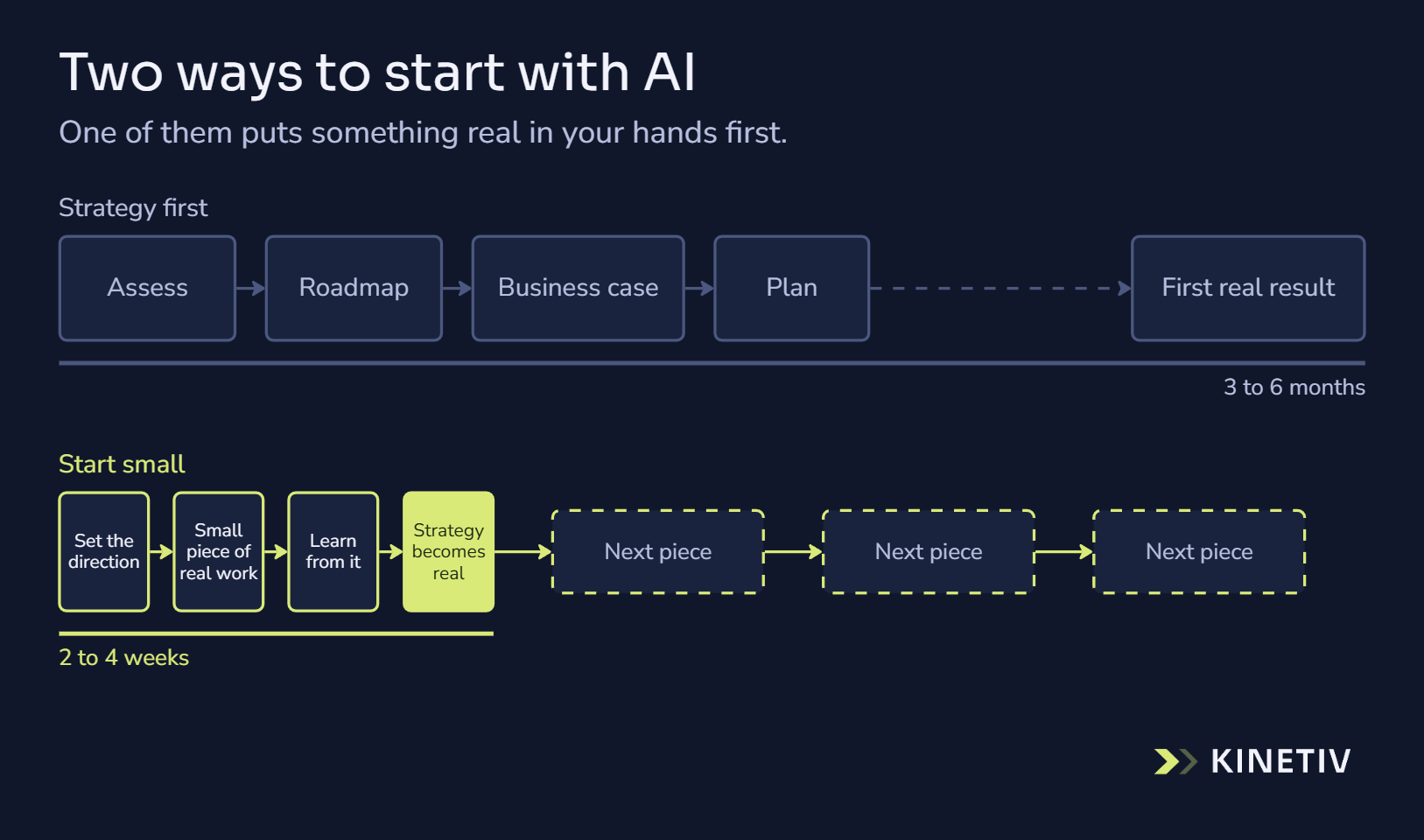
Plan just enough, then start.
One small, whole piece of work
For the bank, that piece was the requests coming into his comms team. They often arrived missing details, and someone spent time chasing people down for what was missing before the real work could begin.
That was small enough to build quickly and whole enough to matter: a request comes in, and it either becomes a usable brief or a clear reply asking for what's missing.
Within 24 hours of that first conversation, I had a working prototype of a small intake agent. It reads each request, pulls out the details, drafts a brief when the request is complete, and drafts a reply asking for more when it isn't. (I wrote about how I built it in September.)
Our next call was a 90-minute working session, where I showed him the agent working through the kind of requests his team handles every day. Before we'd finished, he said, "Okay, I'm already convinced. We don't need the full 90 minutes."
Why it landed
The prototype wasn't finished. It was a starting point. But it was built on his team's own work, and he could watch it run.
I've seen the same thing with every team I work with. Talking about AI strategy can feel fuzzy, and overwhelming. Seeing AI do a piece of your own work makes it real and tangible.
Starting is how the strategy becomes real
He didn't need a strategy deck to see where AI fit. He needed to watch one small, real piece of his own work get done. After that, the conversation about what comes next had something real to stand on.
If you're deciding where to start, look for one small piece of work your team does every week that takes more time than it should. Start there. If you'd like help choosing, a free AI Planning Workshop is a good first step.